Renal Dialysis Market to reach USD 41.38 Billion by 2035 at 5.6% CAGR
Renal Dialysis Market to Grow from USD 24.0 Billion in 2025 to USD 41.38 Billion by 2035---Powered by Rising CKD
Press Release Disclaimer: This is a press release distributed through the XPR Media network. It has not been independently verified by our newsroom.

Renal Dialysis Market to Grow from USD 24.0 Billion in 2025 to USD 41.38 Billion by 2035—Powered by Rising CKD Prevalence, ESRD Reimbursement Reform
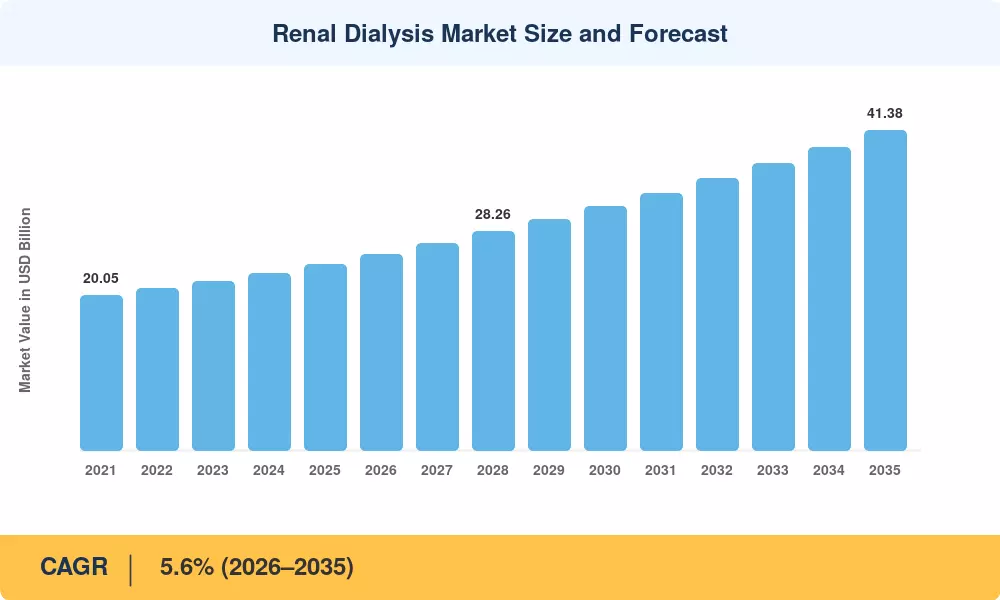
NY, CA, UNITED STATES, September 18, 2026 /EINPresswire.com/ — As per Market Research Future, the global Renal Dialysis Market size is projected to reach USD 41.38 Billion by 2035 from USD 24.0 Billion in 2025, at a CAGR of 5.6% during the forecast period 2026–2035. The market stood at USD 20.05 Billion in 2021.
The 5.6% CAGR—anchored by structural shifts in kidney care delivery—is propelled by three converging forces: the rising global prevalence of chronic kidney disease (CKD), with the World Health Organization estimating that CKD now affects roughly 850 million adults worldwide, driving healthcare systems to expand renal replacement therapy capacity; ESRD reimbursement reform, highlighted by the U.S. Centers for Medicare & Medicaid Services (CMS) raising the End-Stage Renal Disease (ESRD) bundled payment base rate by 2.1% for calendar year 2025 to approximately USD 271.02 per treatment; and home-based therapy policy incentives, including the CMS ESRD Treatment Choices (ETC) model, which ties payment adjustments to home dialysis utilization and is accelerating procurement of peritoneal dialysis cyclers and home hemodialysis systems.
Global dialysis leaders are amplifying this momentum. Fresenius Medical Care—holding an estimated 18–22% revenue share—reported that its AI-based predictive analytics platform reduced unplanned machine downtime by 35% across 250 pilot clinics in North America during 2024. Baxter International is investing more than USD 300 million in next-generation automated peritoneal dialysis cycler systems, while DaVita Inc. continues expanding its integrated care and home dialysis programs. According to the International Society of Nephrology, roughly 2.6 million patients worldwide currently receive some form of renal replacement therapy—a number that could exceed 5 million by 2030, according to Lancet estimates. These forces are creating the clinical infrastructure and patient demand on which the Renal Dialysis Market depends.
Request A Free Sample:
https://www.marketresearchfuture.com/sample_request/1409
Key Market Trends & Growth Drivers
Rising Global CKD Prevalence
The market is witnessing sustained demand growth as CKD stages 3–5 affect more than 10% of adults in over 40 countries, with incidence climbing 29% over the past decade, according to the International Society of Nephrology’s Global Kidney Health Atlas. This epidemiological pressure translates directly into treatment demand, as roughly 2.6 million patients worldwide currently receive some form of renal replacement therapy. Fresenius Medical Care continues expanding capacity through vertically integrated provider–manufacturer operations spanning more than 5,500 clinics globally alongside DaVita.
ESRD Reimbursement Reform
Policy shifts are reshaping provider economics across the industry. CMS finalized a 2.1% increase to the ESRD Prospective Payment System base rate for 2025, bringing it to approximately USD 271.02 per treatment, while the expanded Transitional Add-on Payment Adjustment for New and Innovative Equipment and Supplies (TPNIES) incentivizes investment in newer-generation equipment. Higher per-session payments improve the return-on-investment calculus for capital equipment upgrades across the Renal Dialysis Market.
Home-Based Therapy Policy Incentives
The incorporation of home-based modalities is gaining traction as a structural growth driver. The CMS ESRD Treatment Choices (ETC) model, covering 30% of U.S. nephrology practices, imposes positive and negative payment adjustments based on home dialysis utilization rates—with downward adjustments of up to 5% for providers missing escalating thresholds. This regulatory stick-and-carrot mechanism is driving accelerated procurement of PD cyclers and home HD systems, while remote patient monitoring platforms paired with home machines generate USD 50–130 per patient per month in recurring U.S. reimbursement.
AI-Enabled Predictive Maintenance and Digital Health Integration
Artificial intelligence is changing the way dialysis care is delivered. AI-based predictive maintenance algorithms are lowering unexpected downtime by an estimated 35% in pilot projects across large dialysis networks, while machine-learning systems are moving toward real-time dose optimization. Baxter International continues investing in connected, cloud-enabled cycler technology, reflecting the industry’s commitment to intelligent, home-friendly platforms.
Increasing Prevalence of Diabetes and Aging Populations
The rising incidence of diabetes and demographic aging remains a primary driver of CKD and ESRD. Diabetes prevalence acceleration is contributing to kidney disease burden across Asia-Pacific and the Middle East & Africa, while Europe’s aging population sustains replacement demand for dialysis infrastructure. The market is projected to expand as healthcare providers increasingly invest in hemodialysis and peritoneal dialysis capacity to manage chronic conditions, and the WHO identifies noncommunicable diseases as a leading global health challenge.
Ask for Customization:
https://www.marketresearchfuture.com/ask_for_customize/1409
Market Segment Insights
BY TYPE OF DIALYSIS
Hemodialysis: Largest segment with approximately 86% share in 2025, underpinned by clinical familiarity, established protocols, and installed-base dominance in in-center facilities. Fresenius Medical Care and B. Braun continue strengthening hemodialysis infrastructure through console platform innovation.
Peritoneal Dialysis: Fastest-growing modality, forecast to expand at a 6.6% CAGR through 2035, reflecting policy incentives favoring home-based modalities and patient preference for autonomy. Baxter International leads with its HomeChoice Claria automated PD cycler platform.
BY DIALYSIS PRODUCTS
Hemodialysis Equipment: Largest product category with 60% share in 2025, driven by decades of capital investment in in-center infrastructure and deep consumable lock-in across large dialysis organizations.
Peritoneal Dialysis Equipment: Fastest-growing product segment at a 6.85% CAGR (2026–2035), as automated PD cyclers become easier to operate at home and reimbursement policies in the U.S., UK, and Australia accelerate the shift.
Other Equipment (Water Treatment, Accessories): Valued at USD 2.16 Billion in 2025, supported by replacement and compliance cycles.
BY END-USER
In-Center Dialysis Settings: Largest segment with 82% share of 2025 revenue, benefiting from large dialysis organization consolidation, economies of scale, and centralized clinical oversight.
Home Care Settings: Fastest-growing end-user segment, projected to register a 6.3% CAGR between 2026 and 2035, as connected devices and telehealth monitoring close the safety gap between home and clinic.
Hospitals & Clinics: Significant share, anchored by government-funded kidney-care programs and hospital-based dialysis units in emerging markets.
Read Detailed Insights:
https://www.marketresearchfuture.com/reports/renal-dialysis-market-1409
Regional Outlook
North America — Market Leader in Home-Therapy Conversion
North America leads with over 46% of global revenue in 2025, generating approximately USD 11.04 Billion, driven by high per-patient reimbursement, wide commercial insurance coverage, and the CMS ETC model’s home-therapy benchmarks. The United States accounts for 84% of the regional market, anchored by approximately 7,800 Medicare-certified dialysis facilities and two dominant large dialysis organizations—Fresenius Medical Care and DaVita—that together operate over 5,500 clinics. The competitive landscape is characterized by continuous innovation, AI integration, and LDO consolidation.
Europe — Second Largest Market
Europe held over 27% of global share in 2025, representing the second-largest regional market. The region benefits from aging population pressure and upgrades to the EU Medical Device Regulation (MDR). Germany leads with 24% of the regional share under its DRG-based reimbursement structure, while the UK’s NHS Long Term Plan prioritizes home-first kidney care and France’s regional health agencies mandate minimum home-PD utilization thresholds. Leading players include Fresenius Medical Care and B. Braun Melsungen.
Asia-Pacific — Fastest-Growing Market Segment
The Asia-Pacific region is the fastest expanding, with a predicted CAGR of 7.3% (2026–2035), driven by government-funded kidney-care programs in India and China. China accounts for 35% of the regional share, with the National Health Commission allocating over CNY 12 billion to county-level hospital dialysis units, while India’s Pradhan Mantri National Dialysis Programme has delivered more than 14 million free dialysis sessions since inception. Japan’s super-aged society sustains per-capita dialysis spending among the highest globally, and companies like Nipro, Nikkiso, and Asahi Kasei lead the regional charge.
Middle East & Africa and South America — Untapped Potential
South America was valued at USD 1.18 Billion in 2025 and the Middle East & Africa at USD 0.94 Billion in 2025. Brazil’s SUS public dialysis network accounts for 62% of the South American market, while Saudi Arabia’s Vision 2030 healthcare pillar has earmarked over SAR 60 billion for hospital modernization, including standalone dialysis centers. The MEA region remains heavily underserved—with an estimated treatment gap exceeding 90% in several sub-Saharan countries—creating both a humanitarian imperative and a long-term commercial opportunity for international players.
Competitive Landscape and Recent Developments
The Renal Dialysis Market is low to moderately concentrated, with the top five companies anticipated to contribute 55–60% of global equipment sales and a Herfindahl-Hirschman Index in the 1,200–1,500 range. High barriers to entry persist due to rigorous regulatory pathways (FDA 510(k), EU MDR Class IIb), entrenched consumable lock-in, and extended clinical evaluation cycles.
KEY COMPANIES AND RECENT MILESTONES
Fresenius Medical Care (DE) (~18–22% share): Offers the 5008S CorDiax HD system, PD cyclers, and NxStage home HD platform as a vertically integrated provider–manufacturer. Its AI-based predictive analytics platform reduced unplanned machine downtime by 35% across 250 pilot clinics in North America during 2024, and the company continues advancing digital tools such as AR-assisted training for its multiFiltratePRO system.
Baxter International (US) (~14–18% share): Investing more than USD 300 million in next-generation automated peritoneal dialysis cycler systems. Its HomeChoice Claria PD cycler received FDA 510(k) clearance featuring cloud-connected dose tracking and remote clinician alerts.
DaVita Inc. (US) (~8–12% share): The largest independent large dialysis organization network, operating over 5,500 clinics alongside Fresenius. DaVita continues expanding integrated care services and home dialysis programs, with planned patient training centers aimed at improving home-therapy retention.
Other Key Players: Nipro Corporation (JP), B. Braun Melsungen (DE), Nikkiso Co. Ltd. (JP), Asahi Kasei Medical (JP), Medtronic plc (IE), Cantel Medical/Steris (US), Toray Medical (JP).
Future Outlook: 2026–2035
The Renal Dialysis Market is projected to reach USD 41.38 billion by 2035, growing at a CAGR of 5.6%, driven by rising CKD prevalence, ESRD reimbursement reform, and home-based therapy policy incentives.
New opportunities lie in:
Portable and wearable device development, including wearable artificial kidney prototypes targeting regulatory submission before 2028
Telehealth-integrated home monitoring platforms creating recurring software-as-a-service revenue layers
Emerging market capacity expansion through government-funded dialysis programs in India, China, Indonesia, and Egypt
By 2035, the Renal Dialysis Market is expected to achieve substantial growth and innovation, potentially bifurcating into a conventional equipment tier and a wearable therapy tier that could shift 10–15% of patient volume away from fixed installations.
More Related Research Insights:
https://www.marketresearchfuture.com/press-release/animal-health-market
https://www.marketresearchfuture.com/press-release/sound-therapy-market
https://www.marketresearchfuture.com/press-release/wound-care-market
https://www.marketresearchfuture.com/press-release/functional-service-providers-fsp-market
https://www.marketresearchfuture.com/press-release/in-vitro-diagnostics-market
https://www.marketresearchfuture.com/press-release/medical-second-opinion-market
https://www.marketresearchfuture.com/press-release/saudi-arabia-medical-devices-market
https://www.marketresearchfuture.com/press-release/beauty-devices-market
https://www.marketresearchfuture.com/press-release/dental-industry-market
https://www.marketresearchfuture.com/press-release/healthcare-artificial-intelligence-market
https://www.marketresearchfuture.com/press-release/hemorrhoids-treatment-market
https://www.marketresearchfuture.com/press-release/medical-aesthetics-market
https://www.marketresearchfuture.com/press-release/organoids-market
https://www.marketresearchfuture.com/press-release/atopic-dermatitis-market
https://www.marketresearchfuture.com/press-release/blue-biotechnology-market
Market Research Future
Market Research Future
+1 855-661-4441
email us here
Legal Disclaimer:
EIN Presswire provides this news content “as is” without warranty of any kind. We do not accept any responsibility or liability
for the accuracy, content, images, videos, licenses, completeness, legality, or reliability of the information contained in this
article. If you have any complaints or copyright issues related to this article, kindly contact the author above.

Media gallery